Simulation Series
Simulation Foundations — Why Time Shapes Everything
The essential theory behind time, motion, and numerical integration in real time systems.
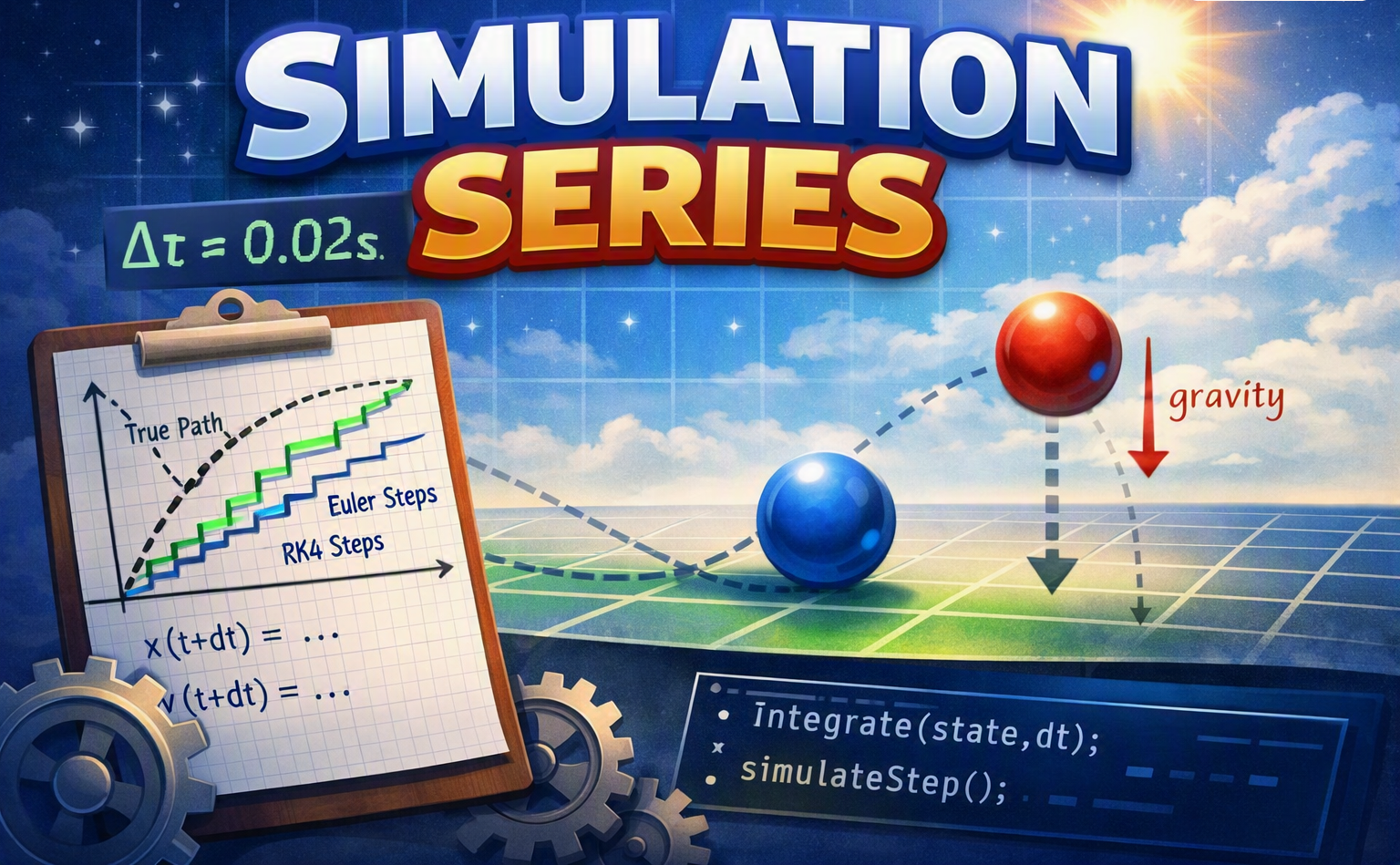
BeforeTheMesh is built on three pipelines — Programming, Graphics, and Geometry — each with its own learning arc. Simulation sits at the intersection of all three, but it belongs firmly in the Programming pipeline. This mini series isolates the simulation concepts so you can master them without jumping prematurely into OpenGL or rendering.
Once you understand how time and integration work, future tutorials will show how to visualize simulation data, how to apply geometry for collisions, and how to integrate physics into the full engine.
Real time engines live in a world that doesn’t exist in nature. In reality, time flows continuously. In a computer, time arrives in discrete slices — tiny packets called frames — and every simulation must decide what to do with them. This mismatch between continuous physics and discrete computation is the core challenge of simulation, and it is the reason this mini series exists.
The Simulation Series introduces the conceptual and architectural foundations that allow an engine to move objects, apply forces, integrate motion, and evolve a world consistently over time. Whether you are building physics, particles, animation, or AI steering, the ideas here form the heartbeat of everything that follows.
In the series we will address issues like:
If you are building your own engine, or simply want to understand how real time systems stay stable and deterministic, this series is the perfect starting point.
Temporal Discretization, Timestep Strategy, and Numerical Integration in Real-Time Simulation Engines
A practical architecture for time, forces, bodies, worlds, integrators, and system orchestration
The
Visit the official BeforeTheMesh GitHub repository to download the complete Simulation Subsystem source code, explore the modular architecture, and experiment with the simulation system yourself.